Tuesday, February 17, 2009

We spent the night in Toluca, the capital of the state of Mexico.  I was impressed by two things: the cold (I hadn’t brought enough warm clothes) and the botanical gardens, which are in a former covered market.  The market's windows have been replaced by an incredible stained glass mural.  The plants are varied, well labeled, and include a medicinal section.  Nearby is the town of Metepec, which is the home to the principal artisans of the “árbol de la vida” ceramic creations.  I found Metepec to be much more charming than Toluca, and wished we had spent the night in the smaller city (now a suburb of Toluca).  

A new cultural activity: lawn-sweeping

Although I have heard it said that US lawns all look (too) pristine, I thought our ex-landlady’s request that we sweep the dead blossoms off our lawn was taking “too pristine” to a whole new level.  However, sweeping the lawn is not such an abnormal things here, as I’ve observed.  Regina was more than happy to participate in a new cultural activity. 

Thursday, January 29, 2009

The Big Move

On Tuesday, Regina and I moved from the house we were in on Calle Georgina to a little bungalow in a (gulp!) gated condo community called Torres de Cuernavaca.  For those who have visited already,  I have good news: we are all of a 3 minute walk from the old house.  We have traded the neighbor's "shut up you *&*$*#*$ dog!" for the crowing of a rooster in the morning and small groups of children playing with sticks.  Just like with the dog's owner, I plan to stay out of their way.   Although we will miss the life that passed by our gates everyday (the tamale seller, the knife-sharpener, the gas seller, the old metal buyer, the random groups of musical-instrument players asking for money, and the occasional Mormon), we are thrilled with the running trail we can take around the other buildings, the small soccer field, and the pool.  Other highlights are our new landlords, one of whom is a co-worker of mine, and the washing machine!   

Inauguration Day

 It was still very, very dark when we awoke at 5:30 on Tuesday morning, Jan. 20th.  Based on our last morning rush-hour experience in D.F., we had vowed to take no chances with the traffic for Inauguration Day.  Sure enough, the normal one-hour bus ride into the capital took  Heron with with our new president!
an extra half-hour, and the metro was a crush of people.  We each had a backpack, Heron's full with a month's worth of travel experience, so we used our bags to help cram our way onto a metro car.  "If we get separated," we told each other, "we'll meet at Balderas," naming the metro stop.  We had no contingency plan for separation of limbs from bodies, or what to do if the mad rush of people smashed the air out of our lungs.  These were potential problems best left unspoken.  
It's spelled K-E-R-M-I-T.  No joke. 
    
We made it to the Embassy's Benjamin (Ben-ha-MEEN) Franklin Library, and the guard doing the rub-down was remarkably non-plussed at the sight of our backpacks.  Luckily, my underwear was safely at the bottom when he did the revision of the contents.  
    The event started at 9 a.m., which is when they let the guests through the metal detector and into the library.  (This was after the bomb-sniffing dogs were lead through the library).  We gathered with a large number of guests, the ambassador, and a few other ex-pats to watch the CNN coverage.  It was moving, electric, and one could not help but feel a profound weight watching, from within another country, our new president talk about the United States and how it would interact with other countries.  I couldn't help but notice how the crowd was very quiet at any mention of the former president, and applauded enthusiastically for Obama.  
     Fellow Fulbrighter Gretchen reacts in a normal way to having a dozen microphones jabbed in your face. 
    Afterwards anyone who looked like they might not be Mexican was accosted by reporters.  The ambassador high-tailed it out of the room, leaving us to supply the comments.  We were asked such light questions as, "What do you think about the US invasion into Iraq?" and "How do you think Obama should deal with the economic crisis?"  I'm as curious as the reporters are to see what Obama does his first year.  
    Well, my degree in Spanish allows me to say this about the economy...   

Sunday, January 11, 2009

The legend behind the smog

This weekend with my brother, whose visit so far has also included the pigs and rabbits at my school, we traveled by bus through Cuatla to the town of Amecameca, or "Ameca," to the locals.   We visited the local church, ate cecina, rice, beans and enchiladas in the market for lunch (the sausage we also tried brought the pig visit full circle), and strolled around the zócalo to get our bearings.  But our main goal was to get into the mountains, or at least get as close as we could to the legendary volcanoes, 17,154 foot Iztaccihuatl and her neighbor,17,802 foot Popocatépetl. 
     The Aztec legend about the two mountains is a classic story in Mexico.  Ixta, the daughter of Aztec king, fell in love with a lesser noble named Popocatépetl.  Her father forbade the marriage, but she insisted, and he acquiesced, but on one condition: that Popo help the
 king's troops in battle against the king's enemies.  Of course, the king meant for Popo to die in battle. During the battle Popo and his men were betrayed by the Aztec troops, who left them on their own against a massive enemy attack.  Everyone assumed that Popo and his men had been killed.  Ixta was told that he had died, but she refused to believe that he was truly dead.  Sure enough, Popo made his way back to her, and they escaped one night to start their new life together.  The lived in a hut, a simple but happy life, until one day Ixta became ill, and Popo was unable to save her.  That same afternoon, an earthquake shook the ground, and two volcanoes  formed. A voice told Popo to take Ixta's body to the peak of one of the volcanos, which he did, placing her body on a bed of flowers.  Lying by her side, he died, leaving th
eir two bodies to be covered by snow, forming the two mountains we see now: Popo, the smoking volcano, and Ixta, the mountain in the shape of a woman on her back, hands folded, feet facing Popo.   

    We were disappointed to see the thick smog that covered most of the valley.  We had come from pretty bad pollution in Cuernavaca, and had hoped to give our eyes and lungs a break.  We climbed up to a church that sits above Amecameca and looked across the town towards 
the mountains (see photos).  You can imagine how beautiful the view would be if the smog was not there.  Compare the photos with the one I took in Grenoble, France of the Dauphiné Alps.  The photo was also taken in January, and although the weather was different (France: cold, Mexico:not) there is little evidence of the inversion layer normally created by cities.  Most of the pollution in the Amecameca area comes from DF, which is just over the hills (to the right in the photos).  But it left me wondering what I can do to work on air pollution while I'm here...

Saturday, January 3, 2009

La noche de los rábanos is not the only thing in Oaxaca

For Christmas, or la Navidad, we flew to the city of Oaxaca (located in the state of Oaxaca) with some family friends who were willing to satisfy my curiosity about the famous (in my mind) "Noche de los rábanos."  The Night of the Radishes has fascinated me every since I read Sandra Benítez's book Night of the Radishes. Hence, the trip to Oaxaca, which besides radishes has beautiful textiles, great food, and a rich Zapotec Indian heritage.  
       La noche de los rábanos is held the night of December
 23rd, and the carvers who turn the foot-long radishes into children, animals, stars, and fantastical creatures start growing their subjects several months before.  A huge display is set up in Oaxaca's zócalo, and an elevated platform wraps around the exhibits.  Starting at about 5 pm, a long line forms to access the walkway, which is heavily guarded by police.  To keep the radish creations fresh, the carvers spray them with water periodically 

during the evening, and even at 7 o'clock you can tell why the radish night is only one night: radishes just don't last that long!  

      Radish night having ended, we spent the rest of our time in Oaxaca visiting Monte Albán, a Zapotec ruin with an unusually small ball court and interesting carvings of genitally mutilated men, thought to be conquered leaders from other tribes (quite the way to assert your power!) Oaxaca's textiles are incredible, and the city of Oaxaca is like an art museum - everywhere you turn something beatifully woven, painted, or created out of ceramic, silver or gold beckons you....  On Christmas Eve, the churches were full for pre-midnight mass and midnight mass celebrations, and right around midnight the night sky erupted in fireworks and the whizzes and bangs of the all-too familiar cohetes, or rockets.  The next morning was very, very quiet as the locals slept off the effect of the late-night meal, traditionally turkey, eaten between midnight and 3 a.m.             
   Another Oaxaca Christmas tradition out is the eating of buñuelos and the breaking of their bowls.  Buñuelos, or fried dough served with sugar or syrup,  vary in form from place to place, but in Oaxaca they take the shape of a flattened disk, deep fried, served with a sweet red
sauce.  We were happy to share one between five people, since the one we had really tasted an awfully lot like the grease it was fried in. Here's John, sharing a piece: 
     The tradition is to then take the plate or bowl the buñuelo is served in and break it.  In this case, the buñuelero had erected a bin with a sheetrock back wall.  Breaking your dish is supposed to bring you good luck for the coming year.  Since mine bounced off the sheetrock, and only broke when it hit the other plates on the ground, I'm not sure what kind of luck I'll have this coming year: perhaps I'll just bouncing back from any set-back? 

Friday, December 19, 2008

The Virgin and the Baby that Wasn't Born in December

     Yeah, I know, what a way to ruin Christmas by pointing out that Jesus really wasn't born in December.  But in a country as Catholic as México, nobody is really going to care.  Besides, Christmas here lasts almost until the month people think Jesus was born (March).  More about February 12th and why you don't want to eat your cake and get Baby Jesus later.  
The holiday  decorations started showing up around November 15th, and by Dec. 1st the poinsettias (nochebuenas) were out in full force.  People have lined the roads with their stands of piñatas and poinsettias, and I've been impressed by the variations in both products.  The poinsettias are mostly red, but I've also seen the white-flecked and green-flecked ones.  The piñatas range from HUGE to tiny, and I have to resist the temptation to buy one of each
 size.    
      On December 12th, pilgrims flocked to the Virgin of Guadalupe Basilica in Mexico City - many started some days earlier, walking or crawling.   The expression of faith was moving - so much energy towards one entity cannot be ignored. The Virgin of Guadalupe was proclaimed the Patroness of the Americas by Pope John Paul II in 1999, and the miracle of her image has been unexplained by modern science.  More info at: Our Lady of Guadalupe - Wikipedia, the free encyclopedia
      December 16th saw the start of the posadas, the very Mexican tradition that sprung from the combination of Aztec traditions of music, dance, and public religious events and the Catholic zeal to save souls.  Franciscan priests discovered that the local population liked to participate in the pastorelas, or religious plays, and from that the posadas, or the physical recreation of the journey of the Holy Family, became a common practice.  The posadas last until December 24th, which is the big day of the Christmas celebration.  Right now I can hear a posada party rockin' down the street - after the traditional call-and-response song, the posada recipients receive food from the host, and then the kids get to whack at piñatas.  
    I'll be spending Christmas in Oaxaca, with some friends who are trading the snowy Northwest for 75/80 degree Oaxaca weather.  One of the highlights will be December 23rd's Noche de los Rábanos, or the night of the radishes.  Not only can you eat them, but in Oaxaca you can grow huge ones and carve them.  I'll be sure to document the night thoroughly.   

Sunday, November 23, 2008

T-day in México

I've invited my whole English department for a little cultural event at my house this Thursday.  They are coming after work; I am taking the day to cook.  Can't any American cook a turkey?  I hope so! Here's a running diary of the experience:

Oct 30- See ad on Cuernavaca expat listserv for organic turkeys. 
Nov. 8 - Decide to buy organic turkey.  Email contact, who asks me to pay for half upfront and the rest when we get the turkeys.  Is this something I would do in the States? I decide to go for it.
Nov. 9- Regina and I are truly not sure what day T-day is.  This goes on for some time, until a few days later we look at our American calendar.  Oh.  
Nov. 11- Meet turkey contact, who turns out to be a dynamic mom of 3 bilingual kids.  She is married to a doctor who is currently in Geneva.  I think this will turn out ok.  I hand over
 my 200 pesos. 
Nov. 14 - Plan menu, revise yams for a salad, since I can't find raw yams anywhere (I've looked in 2 towns).  Remind myself I will need to go to at least 4 stores to find everything.  
Nov. 22 - Guest list is up to 7.
Nov. 23 - Tianguis (store #1): buy veggies. Discard salad idea. No sage to be found.  Store #2: Look for turkey and pie pans and sage.  No luck.  Store #3: Find flimsy turkey pan.  Buy potato chips and beer - I'm going to need them this week. Start to worry about stuffing. 
Nov. 24 - Coffee/kitchen supply store (store #4) sells me a meat thermometer.  Espresso, frying pans, and meat thermometers- my kind of store! 
Costco (store #5) run for wine, butter (scratch that - all they have is unsalted), and of all things pumpkin pie!  I feel mildly pathetic for buying a Costco card, but the idea of being able to take pumpkin pie to my kiddos  makes me feel less pathetic.  
Turkey connection emails; the bird lands tomorrow, NOT Wednesday as originally scheduled. The pies suddenly look like a problem.  
Nov. 25 -  Eat potato chips and drink beer while waiting to pick up turkey.  
Regina goes to store #6 for butter and yams. 
Nov. 26 - T-minus 1.   Pies go to school and the Pilgrims are defrocked as robbing, land-loving interlopers (well, in my classes at least).  
    I bake the apple pie, improvising with a wine bottle to roll our my crust, (the hardest part was emptying the wine bottle, but we managed).  Discover oven appears to have a slight tilt forward.
Nov. 27 -  Turkey turned out beautifully, our Southern friend saved the gravy, none of the guests thought any of the food was disgusting, and we have left-overs (yeah!) :)


el 20 de noviembre

The 20th of November celebrates the beginning of the Mexican Revolution of 1910.  The ideals of the revolution were based on Zapata and other's beliefs in land rights (land for those who work it) and free education for all.  It was recently pointed out to me that every 100 years Mexico has a revolution (the independence movement started in 1810), so watch out travelers in 2010! 
      In my school we got the Monday off, and spent a few hours ensayando (practicing) the paso doble (a marching - and dancing- step), and the "at ease" and "at attention" required for the parade. Sounds like the military?  It did indeed sound like the military, especially with the PE instructor using his megaphone to shout out commands.  But having seen the same thing in Ecuador, I wasn't shocked (I definitely was shocked to see the kindergartners  in Ecuador marching military-style), and since I had a group to manage, I practiced my own pasos dobles... most of the time.  Mostly I busied myself to making sure they were in straight lines and that E.H. didn't throw rocks at M.P. and A.R. didn't keep switching lines.  I also kept thinking how getting kids in the US to do the same thing would be like herding cats - here the kids have been doing the same thing for years, so they're used to it.  
            On Thursday, Nov. 20th all primeros (first year, first semester prepa kids) lined up and marched out of the school to town, where we were joined by all the other schools (K-9).  We marched through town, turned around, and marched back, and at about 10 am we were done and the kids all had the day off.  Yes, another day off- but what a sight to see all the students marching through town with community watching proudly.  We could use a little civic pride like that.   

Monday, November 3, 2008

Death and the Lady

The month of August was dedicated in the Aztec tradition to the goddess Mictecacihuatl, "Lady of the Dead."  This goddess of death has come to be known as La Catrina in current Día de los muertos tradition, and she is portrayed as a sexy, bony skeleton dressed to kill.  
    Cuernavaca celebrated its 2nd annual La Catrina competition this year, and the Catrinas wer
e quite something.  Made out of a wire and paper maché body, their clothing ranged from an outfit made out of candy to a gold creation imitating the Ángel statue  in D.F.  While each had a skeleton head, they are in no way frightening or malevolent.  Rather, they are Death as a sex symbol, Death as a lady, Death as something you might not mind spending time with.  
     The other tradition that casts death as something other than terrible is the writing of calaveras.  Calaveras, lterally "skulls,"are verses that make fun of death, usually mixed 
with a politician.  The writing of calaveras were inspired by the illustrations of José Guadelupe Posada.
 
 "Death, " wrote Posada, "at the end of it all, is democratic, and everyone, rich, poor, white, brown, ends up being a skull."   He drew notable figures of his time as skeletons, and made popular the image of the Catrina with a flowered hat (image).  
      My students were able to whip out calavera rhymes in a matter of minutes, which impressed me.  Here are two: 
          Estaba la maestra Reed Scott                                      
          tomándose contenta su taza de arroz                          
          llegó el maestro Santiago                                             
         y del susto le dio la tos.                                        
      
                             - Medardo
        There was the teacher Reed Scott
         contentedly drinking her mug of rice
         Teacher Santiago arrived  
         And the fright gave her a cough.  
                              

          Estaba Rubi comiéndose un budín                          
         cuando de repente llegó la calavera                        
         y se echó un pedín.    
                           - Erick 
            There was Rubi eating a tart
            when suddenly Death showed up 
            and let out a little fart.  
                                                    (changed to keep rhyme) 
    
To me, the Catrinas  and the tradition of writing calaveras embody the Mexican ability to make fun of death, laugh at her, tease her, and ultimately, allow the love of life to triumph over death.  

Día de los muertos

     Many people in the US are familiar with the "Día de los muertos," term, or Day of the Dead, but I think what is often forgotten is the celebration behind the day.  We are so accustomed to death being equated with sorrow, fear, and all that is bad, that to rearrange one's cultural perspective and consider death as part of the journey of life, as did the pre-Hispanic cultures, can be a difficult shift.  The Aztecs and other indigenous groups set aside specific months for remembering and honoring the dead, and it was (and still is, in Mexico) believed that the dead came back during that time.  In the small town I visited, signs stating "Welcome Back Dad!" or "Here is your house, Mom!" were set up over the entryways to the houses that had ofrendas. 

The Spanish Catholic missionaries, who found the Aztec celebrations to be too light-hearted and, dare I say, flippant, in their attitude towards death, moved the Aztec August and November celebrations to coincide with the Christian celebrations of All Saints Day and  All Souls Day. However, their efforts to eradicate traditions of the Aztecs were in vain.   While the pre-Hispanic ceremonies have been shortened to 4 days (starting Oct. 28 and going until Nov. 2), the spirit of 
the celebration is still alive: it is a time to welcome back the departed, to help them on their journey, and to remember with joy the time they lived among us.  
     Each  area in Mexico has its slightly varied take on the day, but the staple of Día de los muertos is the ofrenda, or altar.  Altars represent the deceased, and often include their favorite food and drink, and a photo.  In Ocotepec, the town I visited, ofrendas for the recently deceased include their clothing laid out with a sugar skull at the head area.  Altars traditionally have the four elements of water, air, fire and earth 
represented.  Water is to calm the dead's thirst, fire, represented by the candles, to symbolize purification, wind, represented by the movement of the papel picado, and earth, often represented by the bread pan de muertos.  Copal, an incense made of resin, is also burned on every altar.  Here in Morelos mole, limes, mandarin oranges, and tamales are also considered to be standard elements.  
      In Ocotepec, the night of Nov. 1st is the night to welcome back the adults who have died (children are celebrated the days before).  Each family in the town creates a huge ofrenda to the deceased, and welcome in visitors, who follow the cempasúchil-marked path to the ofrenda. Cempasúchil is the Nahuatl word for marigold, which the traditional flower for the day.          
           As we entered each home, we gave our candle to a family member, stood before the altar in silence for a few moments, and then walked out of the room, where another family member handed us something to eat and drink.  The food varied - in some houses we were given slices of pan de muerto, in one house we were given a tamal.  The drinks were either a hot ponche of fruit or coffee.  Each house must have seen over 500 visitors that night.  
     After we visited the ofrendas, we went to the panteón, 
 or cementerio.  Candles, papel picado, and cempasúchil had been brought during the previous days to the children's graves, and many adult graves had been decorated as well.  We were not the only people in the cementary - besides other tourists, many family members had come out to sit beside graves and tend the candles.   Unlike a typical US graveyard, this one was alive with light, music, and people. 
     We returned to the panteón the next day.   The activity was amazing - families gathered to clean gravesites, place more flowers, and eat food together.  Teenagers and children hung out between the graves, and food vendors crowded the entrances to the panteón, selling everything from sandwiches to ice cream.   A twelve-piece band played most of the morning and a Mass was celebrated in the early afternoon.  
     Inspired by our surroundings, Regina and I set up our own ofrenda earlier this week.  Instead of cempasúchil, I placed roses in memory of Bobbi, an amazing gardener,and Regina laid out a dictionary in memory of her grandmother's love of crossword puzzles.    
     

Sunday, October 26, 2008

Halloween in Mexico

   It was really like any other Halloween party - the devil and his angel girlfriend, a few witches, a Batman, his belly straining against his belt, a princess, and Abe Lincoln (from Salem, OR).  What set this party apart was the salsa/duranguense/merenge dancing (the men could really hold their own!), the tickets (70 pesos) to get in, the michealadas (beer with lime juice and salt) and the  unfinished "finca" (a large house with land - in this case, a large front yard).   People are ingenious in figuring out ways to make money here, and throwing a party is just one of the many, many methods used.  I had no idea Halloween had become so popular in Mexico - some people are concerned about its growing influence, and it's true that I have seen altars for the Día de los Muertos decorated with orange and black cats and pumpkins.  But in a city like Cuernavaca, where almost 90% of the people I talk to have been to the US, it will be impossible to keep all US culture at bay.  If anything, I think I'm glad to recognize that the US even has some culture to export - and of course, anybody likes an excuse to party.  How do you think the US ended up celebrating a small town's win in a battle against the French on May 5th? 

Friday, October 24, 2008

Dolores Hidalgo

Dolores Hidalgo was renamed after the war for independence in honor of the priest who started it all: Miguel Gregorio Antonio Igancio Hidalgo y Costilla Gallega Mondarte Villaseñor (a.k.a. Miguel Hidalgo).    The town is a mere hour bus ride from Guanajuato, so on our way back stopped in to see the church and the town where the famous "Grito de Dolores" happened on September 16th, 1810. 
In the picture, you can see a statue of Hidalgo with the church from where he made his famous proclamation for freedom.  Yes, his statue is wearing a toga - and no, that's not historically accurate clothing.  
   After declaring that the fight for independence was ON!, Hidalgo went to Guanajuato, where the first battle for independence was fought at the Alhóndiga.  Hidalgo was betrayed on March 21st along with three other revolutionary leaders, José Mariano Jiménez, Juan Aldama, and Ignacio Allende.  They were killed in June, and their heades were placed on the four corners of the Alhóndiga, where they hung until 1821, when Mexican independence was finally won.  
     The 200th anniversary of the Mexican Indepence is coming up in 2010, and there are electronic countdown markers in all the major cities.  Considering how the 16th is celebrated, the bicentennial will be a heck of a party!

Guanajuato

Guanajuato has always been one of my favorite cities.  Built in 1546 in a rambling, cobblestoned style reminiscent of Spain's Toledo, it is the capital of the state of Guanajuato.  The wealth of the silver mines was transmitted to its beautiful, Baroque-style churches.   The city is also famous for the Alhóndiga, a  fortress-like granary, that was the site of the first battle for independence in 1810.   The name comes from the native Tarasco word "Quanashuato,"(place of the frogs). 
     I first visited Guanajuato 16 years ago, at the age of 16.  I came with the other exchange students from my high school, and we visited 
the callejón del beso (with its famous legend of love leading to murder), one of the silver mines, and the mummy museum.  Much is the still the same in the city, although you can now only stand on one of the 
lovers' balconies.  
But the story of the callejón del beso remains: two lovers, she the daughter of a wealthy family, he a poor silver miner, fell in love.  The balconies of their houses were separated by a mere 30 inches - a distance their lips easily conquered.   Her father, upon discovering what was happening between the two, became enraged.  At this point, there are two versions: either that he killed her on purpose, or, discovering the lovers kissing across the balcony again, shot her lover and accidentally killed her.  Regardless, she, in her last dying moments, reached out her hand to her lover, cursing her father.  Some say her ghost remains, although the gift store that now controls the access to her balcony didn't mention any problems with ghosts!

      Guanajuato's Museo de las momias is probably one of the oddest 
things you can see in Mexico.  Akin to Philadelphia's Mütter Museum, it is a display of that which you do not normally see - in this case, desiccated bodies of the poor (including babies) whose families were unable to pay the yearly burial tax.  It's an odd experience.  
        
Guanajuato is the also the site for the annual music/art/theater festival, Festival Cervantino.  We stayed right in the heart of the action at a charming bed and breakfast called Casa de Pita (Pita herself made us breakfast every morning and entertained us wit
h stories of former guests).   Street musicians, modern theater groups, interpretative dance, a parade with elaborate costumes- you name it, we saw it.   The best part was that a good number of the musical performances were open air, so you could stand in the street and listen for free.   
On our busiest day, we went to one art exhibit, two museums, had lunch with Fulbright friends, went to the market, listened to parts of three open air concerts, watched an interpretative dance and theater performance, and ate a late night snack of tacos while listening to the estudiantinas, a group of university student musicians who lead a happily drinking crowd around the streets at night, playing music and singing the whole time.  

Monday, October 6, 2008

Cursos

With a little bit of cooperative learning, use of rubrics, and how to clean the computers mixed into the instruction, our course on the use of the language laboratory software began today.  The positives:

1. The software expert knew something about effective teaching methods. 

2. We got lots of  time to become familiar with the two programs we use, TellMeMore and EduStar. 

3. The English department (all three of us) finally got together!!!

4. Maybe I worked on my blog entries.  

The negative:

1. All the time to work has a price. It was decided that the best way to educate us on the software was to pull us out of our English classes for 5 days,  (approximately 6-8 hours of instruction per student group). 

2. I now know it is possible to be told to read the manual over 10 times in one training. 

3. Surprise!  This curso goes until 6 pm every day.  (We managed to negotiate a slightly different time frame for the other days, and I politely excused myself at 3 today, explaining I had prior obligations, which I did!).  

Jilotepec

            Without knowing exacty where we were headed, Regina and I left Cuernavaca on a 9:30 a.m. Pullman bus.  Three buses and five hours later, we pulled into overcast and rainy Jilo, a town of 40,000 (maybe?), where a fellow Fulbrighter, Jen will be teaching during her Fulbright stay.  If I had been able to find Jilotepec on the map, I would have realized we were headed north, and minded more Jen’s warning that it was cold!  After so many weeks in Cuernavaca, I have become used to “cold” meaning about 64 degrees.  Jilo’s chilly weather caught me by surprise, but Jen was a fabulous host – in addition to cooking amazing meals, she lent me her husband’s wool slippers, which saved me! 

            Jilo’s tianguis is the largest I’ve ever seen, with a huge array of products.  Need industrial toilet paper?  Check.  50 pounds of dried chiles? Check.  Baby chicks?  Check.  Electric heater? Check. (But it might not work, and be prepared to just stand there until they give you your money back, as we found out). 

            In front of the church in Jilo stretches a large area called “the garden,” where

 amorous couples check each other’s dental work.  Inside the patio attached to the church, a long rope dangled from the roof; at five o’clock a woman came out to pull it, clanging the church bell through all of downtown Jilo.   

          We spent a day with Kate, another Fulbrighter, in the tongue-twisting town of Tequisquiapan, where the weather was warmer and the church on the main square was hopping - we watched a wedding give way immediately (i.e., they were parked outside waiting for the bridal party

 to move their car) to a fifteen-year old's quinceñera mass.  

       In addition to travels, I've also managed to erase my iphoto library, although the fotos are there, somewhere, so we'll all have to suffer without a lot of visuals.  


Monday, September 22, 2008

I'm doing what??? part II

Monday morning, 7:30 a.m.  The campus is oddly quiet.  I find out why: classes have been cancelled, and the primeros (first year prepa students) are taking a beginning-of-the-year diagnostic test while everyone else gets the day off.  A chosen few - 13 - of us are going to be in a workshop all day to learn how to run tutorías.  I guess the exam prep and oral exams I had planned will have to wait.  Here is some data from my workshop today (yes, my math friends, I crunch numbers when I'm looking for something to occupy myself!)
Complaints (in the first hour): 17
% of people complaining (in the first hour): 53%
# of responses to complaints (in first hour): 3
       Avg. minutes people complained/commented: 2.87  
Longest complaint: 6 minutes
# of hours we were supposed to be in the workshop: 7.5 
   # of actual hours: 6.5
Oh yes, and by the way - we start tomorrow.  

Friday, September 19, 2008

¡Viva México!

El 15 de septiembre is the big night for celebrating Mexican Independence Day.  Fortunately for us, it was also the birthday of a colleague, and he took us out to celebrate both occasions.  Unfortunately, the teachers on strike have completely taken over the downtown zócalo (more power to them!), so the "grito," or re-enactment of Miguel Hidalgo's yell that began the fight for Independence against Spain in 1810, was cancelled.  Instead of doing it in Cuernavaca (the capital of Morelos), the governor went to another city nearby, Cuautla.   We ended up being in a club at midnight, which is when the President rings the actual bell Hidalgo rang to alert the town, and shouts out over the crowd in the zócalo a series of "viva _(insert name/ideals)_" that the crowd repeats.  You can watch what we missed at: 
www.youtube.com/watch?v=1524htZMVOM&feature=related
    We hada lot of fun dancing salsa and watching the waiters, who were all dressed up as girls.  I couldn't figure out a reason beyond giving them an excuse to dance with the singers of the live band.  I've always loved how willing to cross-dress Latin American men can be!  
    We were also treated to an appearance of  the famous Morelos chinelo dancers, who impressed me with their ability to keep dancing for hours under the weight and heat of a heavy costume. In fact, everyone's dancing ability was impressive - every single person here could get a job in the US teaching others how to move their hips.  My years of dancing here and there paid off, and I was able to hold my own on the dance floor, which basically means I didn't step on anyone's feet.  

Tepotzlán

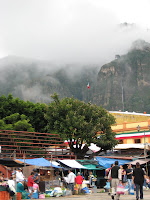
Last weekend we went to Tepotzlán, a town known for its sacred energy and a pyramid that has survived over 500 years.  The town is beautiful.  It's small, surrounded by oddly shaped mountains, and has the best tianguis (market) I've seen yet.  It also is known for the wild variety of nieves, or sorbets, you can buy, although they were a bit too icy for my taste.  However, the flavors are exotic - avocado, tequila with lime, burnt sugar,  cactus, carrot, lettuce... It's quite a list.  
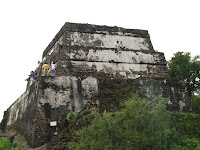
   We hiked up to the pyramid the second day we were in town - us and a crowd of day trippers from Mexcio D.F., who flood Tepotzlán on the weekends, looking for respite from D.F.'s smog.  The hike was a steep 2 km, and wound its way through thick forests and trickling streams to finally break through the trees, climb up a metal stairwa
y, climb some more stone steps, and reach the pyramid, where you have to pay 35 pesos to actually get on the pyramid. But it was worth it!  The view is beautiful, and although the sacredness of the spot is a bit muddied by the young couples making out on the side of the 
pyramid, the recent offerings left by believers made me feel like we were part of something bigger than ourselves.  The trail we climbed was the part of the original path the priests and their devotees climbed in the 1500's.  Wow. 
  
    Tepotzlán is also known for the elaborate entryway to the main church.  The arch that forms  
the entrance is redone every year with a seed mural.  Seeds of all kind -rice, peas, black beans, lima beans, you name it - are used to
create a religious motif showing the conversion of Tepoztecatl, the leader of the native group converted by the Dominicans, Christ's ascension, the Holy Family, and other stories.  
       Although we did not get photos of our auras taken
or a massage, or a tarot reading, or a henna tattoo, we did  met a lovely woman named Carmen from Oaxaca whose family owns a Tepoz business selling rugs  - and we are now the happy owners of two beautifully made wool rugs. This is definitely a town I'd bring visitors to!

Mug shot, multa

¡Éxito!  I was able to file my paperwork yesterday with the Instituto Migratorio.  The only hang-up: I was supposed to have registered with them before the 12th. The multa (fine) is about 450 pesos.  "But," I countered, "I was told to come back today." 
     "Who told you that?" the woman with my paperwork asked me.  
      "Er.... the woman who was working here that day. I could have come of Friday, which was the 12th, but she told me to come back here today, Thursday." I was using all my negotiation skills.  
      "What did she look like?" she narrowed her eyes at me.  
       "Um... she was tall..." I started.  
        "Tall?!"  she repeated, looking confused.  Oh, drat.  What does tall mean here? I thought.
        "Well, kind of tall," I said.  "With brown hair."
         Now the girl looked really perplexed, and a little suspicious.  "Brown hair?" she asked. 
        "Um, yes, pelo café," I said, using a different word for brown.  What does brown hair mean HERE? I thought desperately.  Obviously, our two cultures were at odds with physical descriptions.  
     "Momento," she said, disappearing into a back room.  A woman poked her head out of the door, looked at me, and disappeared again.  Moments later, the woman with my paperwork came back and started stamping things again.  
    "Is everything ok?"  I asked.
    "Oh yes, you're fine," she said.  "Sign here."
     Whew.